

Impact Resistance in Phone Cases – Why It Matters for Families
Every parent faces that stressful moment when a smartphone slips out of a pocket and lands on the pavement. For British families juggling school runs and shopping trips around London, phones need more than just style, they need real defence. With over 80% of British parents reporting phone accidents at home or outdoors, understanding what makes a case truly impact-resistant helps you avoid costly repairs and disappointment. Discover what to look for in a case designed for your lifestyle.
Table of Contents
- Defining Impact Resistance In Phone Cases
- Types Of Impact-Resistant Case Designs
- How Impact Absorption Technology Works
- Uk Safety Standards And Testing Protocols
- Common Pitfalls And Misconceptions To Avoid
Key Takeaways
| Point | Details |
|---|---|
| Understanding Impact Resistance | Impact resistance measures how well a phone case protects a smartphone from damage during daily use, focusing on energy distribution rather than just material strength. |
| Importance of Design | Advanced designs such as multi-layered composites provide better protection through intelligent energy absorption mechanisms and strategic features. |
| UK Safety Standards | Compliance with UK safety regulations ensures phone cases are both mechanically robust and free from harmful substances, offering peace of mind for consumers. |
| Common Misconceptions | Many consumers mistakenly believe that thickness or price equates to better protection, but effective design and material choice are key. |
Defining Impact Resistance in Phone Cases
Impact resistance describes how effectively a phone case protects your device from unexpected damage during daily family life. More than just physical strength, it represents a material’s capacity to absorb and disperse energy from sudden impacts. When considering smartphone protection, understanding impact resistance mechanisms becomes crucial for parents managing busy households.
At its core, impact resistance involves how phone case materials react when subjected to sudden force. Scientifically, this means assessing a material’s ability to dissipate kinetic energy without significant structural deformation. Different case materials like silicone, polycarbonate, and hybrid composites offer varying levels of shock absorption, with some designs specifically engineered to minimise stress transmission to the underlying smartphone.
Research indicates that effective impact resistance is not just about material rigidity, but about intelligent energy distribution. Laminated casing technologies demonstrate how strategic layering can dramatically reduce stress on smartphone screens during accidental drops. These advanced designs work by creating multiple energy absorption zones, preventing concentrated impact forces from reaching delicate electronic components.
Here’s an overview of how common case materials differ in protective performance:
| Material | Shock Absorption | Durability Over Time | Grip and Handling |
|---|---|---|---|
| Silicone | Excellent | Moderate, may stretch | Non-slip, tactile feel |
| Polycarbonate | Moderate | High, resistant to cracks | Smooth, less grippy |
| Hybrid Composite | Very high | High, resists yellowing | Balanced, secure feel |
| Thermoplastic Polyurethane (TPU) | High | Flexible, resists abrasion | Slightly textured, firm |
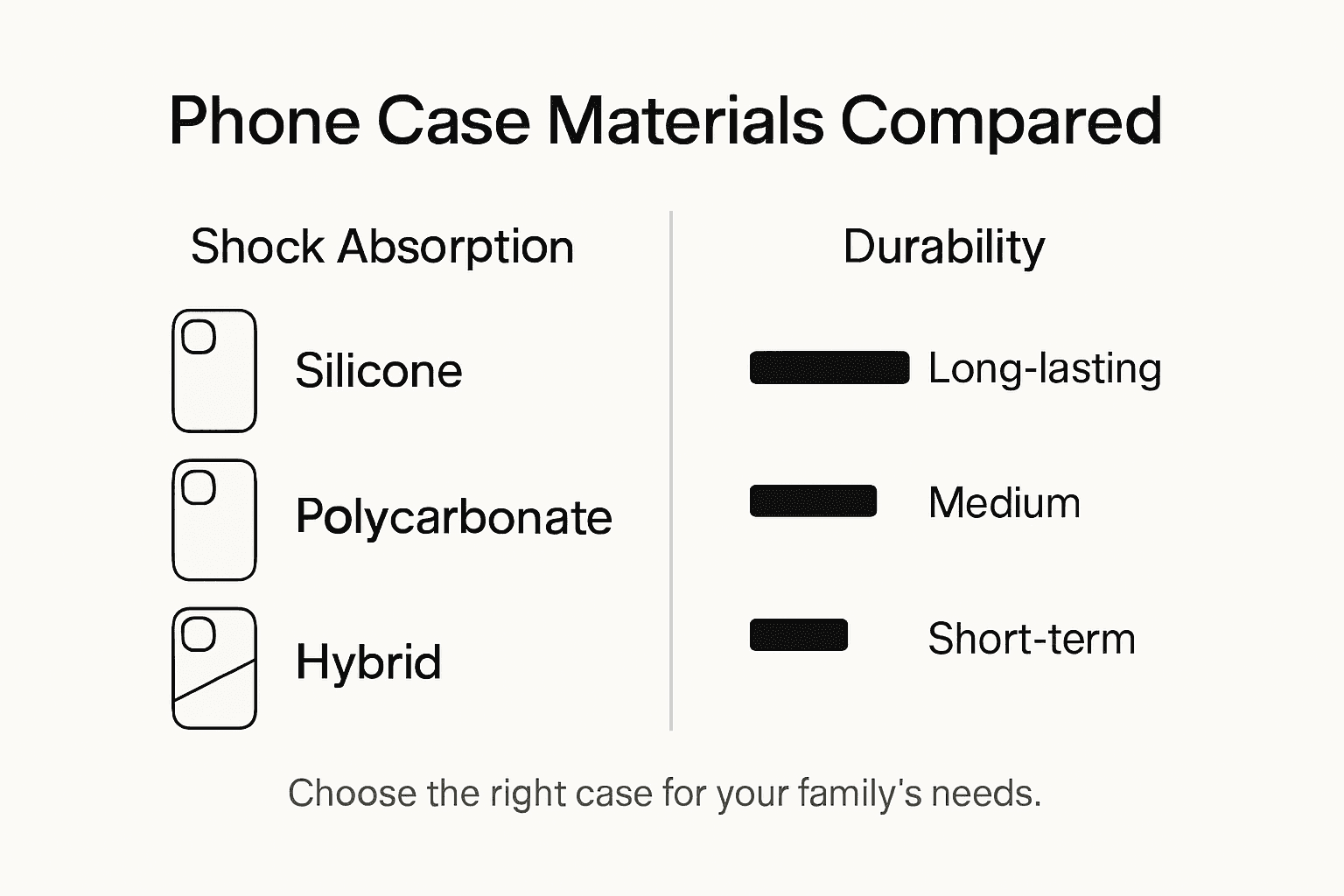
Phone Protection Pro-Tip: When selecting a phone case, perform a simple drop test by simulating real-world scenarios like accidentally dropping your phone while carrying shopping bags or managing children.
Types of Impact-Resistant Case Designs
Modern smartphone protection has evolved far beyond simple plastic covers. Multi-layered composite structures represent the cutting edge of impact-resistant case design, offering sophisticated protection strategies tailored for families navigating unpredictable daily environments. These advanced cases integrate multiple protective elements to shield devices from potential damage.
The primary categories of impact-resistant cases include hybrid designs, rugged cases, and shock-absorbing models. Hybrid cases typically combine rigid outer shells with softer inner linings, creating a dual-layer defence mechanism. Rugged cases feature reinforced corners and raised bezels to protect against direct impacts, while shock-absorbing models utilise specialised materials like silicone and thermoplastic polyurethane (TPU) to dissipate energy during accidental drops.
Engineered protection mechanisms are particularly impressive in modern case designs. Advanced models incorporate strategic features like protruding corner protectors, anti-slip strips, and internal cushioning systems. Some sophisticated cases even include internal airbag-like structures or foam columns precisely positioned to minimise stress transmission during unexpected impacts. These intelligent design elements ensure that kinetic energy is distributed and absorbed before it can cause damage to delicate smartphone components.

Phone Case Pro-Tip: When purchasing a protective case, physically test the material’s flexibility and check for raised edges that can protect your screen during accidental falls.
How Impact Absorption Technology Works
At the heart of modern phone case protection lies sophisticated energy dissipation technology. Thermoplastic polyurethane (TPU) materials represent a breakthrough in impact absorption, offering an intelligent approach to protecting smartphones from unexpected drops and impacts. These advanced materials work by converting kinetic energy into flexible deformation, effectively reducing the force transmitted to delicate electronic components.
The core principle of impact absorption involves creating strategic material barriers that can redistribute and neutralise incoming shock waves. Different materials respond uniquely to impact forces: some compress and spread the energy across a wider surface area, while others use internal structures that act like microscopic shock absorbers. Silicone, polycarbonate, and hybrid composites each provide distinct mechanisms for energy dispersion, with some materials capable of absorbing up to 90% of impact energy before it reaches the smartphone.
Modern impact absorption technologies go beyond simple material selection, incorporating complex engineering principles. Advanced cases now feature carefully designed internal architectures with honeycomb structures, air gaps, and strategically placed cushioning zones. These intelligent design elements work in concert to create a comprehensive protective environment, transforming what was once a simple protective cover into a sophisticated defensive system that can dramatically reduce the risk of smartphone damage.
Phone Protection Pro-Tip: Test your phone case’s flexibility by gently pressing its corners and observing how effectively it absorbs and redistributes pressure.
UK Safety Standards and Testing Protocols
Phone case safety in the United Kingdom is governed by comprehensive regulatory frameworks designed to protect consumers from potential risks. The General Product Safety Regulation (GPSR) establishes stringent guidelines that manufacturers must follow, ensuring that every phone case meets critical safety and chemical content standards. These regulations extend beyond simple design considerations, encompassing comprehensive assessments of material composition, potential chemical hazards, and overall product integrity.
Manufacturers undergo rigorous testing protocols to validate their products’ durability and safety. Impact testing services play a crucial role in this validation process, employing sophisticated techniques like drop tests and pendulum impact assessments. These methodical evaluations measure a phone case’s ability to withstand sudden forces, simulating real-world scenarios such as accidental drops, impacts, and compression. The testing provides manufacturers with traceable data that demonstrates the product’s resilience and protective capabilities.
Beyond mechanical testing, UK safety standards also encompass chemical safety regulations. Manufacturers must comply with REACH regulations, which restrict harmful chemical compositions in consumer products. This means phone cases must be free from potentially dangerous substances like certain phthalates, heavy metals, and other toxic compounds. The comprehensive approach ensures that not only are phone cases mechanically robust, but they also pose minimal health risks to consumers, particularly important for families with children who might come into contact with these accessories.
Below is a summary of UK safety requirements and what they mean for consumers:
| Standard or Test | Focus Area | Consumer Benefit |
|---|---|---|
| General Product Safety Regulation (GPSR) | Overall product safety | Assurance of safe usage |
| Impact Testing | Drop and force resistance | Reduced risk of device breakage |
| REACH Compliance | Chemical composition | Avoidance of toxic substances |
Safety Standard Pro-Tip: When purchasing a phone case, look for manufacturers who voluntarily provide independent testing certification or detailed safety documentation.
Common Pitfalls and Misconceptions to Avoid
Many families fall into predictable traps when selecting phone cases, often prioritising aesthetics over genuine protection. The most common misconception is believing that any case provides adequate protection, when in reality, not all phone cases are created equal. Thickness does not automatically translate to superior impact resistance, and a bulky case can sometimes provide false security without the right engineering.
Another significant pitfall involves overlooking material compatibility with specific smartphone models. Parents frequently purchase generic cases without considering the precise dimensions and button placements of their device. This can result in reduced functionality, such as blocked charging ports, unresponsive side buttons, or imperfect camera lens alignment. Each smartphone model requires a precisely engineered case that accounts for its unique architectural nuances.
Consumers also frequently misunderstand the relationship between price and protection quality. The most expensive case is not necessarily the most protective, and budget options can sometimes offer superior impact absorption. What matters most is the case’s design philosophy, material science, and engineering approach. Some affordable cases utilise advanced polymers and strategic structural designs that outperform more expensive alternatives, demonstrating that intelligent design trumps mere cost when it comes to device protection.
Protection Strategy Pro-Tip: Always test a phone case’s fit and functionality immediately after purchase, checking port accessibility, button responsiveness, and overall device compatibility.
Protect What Matters Most With Impact-Resistant Cases From StudioShake
Families face the daily challenge of keeping smartphones safe amid busy routines and unexpected accidents. Impact resistance is crucial to shielding your device from drops, shocks, and wear. At StudioShake we understand the importance of intelligent design and materials that absorb and disperse energy effectively. Our iPhone and MagSafe case collections combine advanced protection technology with user-friendly features to safeguard your device without compromising style or usability.

Explore our expertly engineered cases now at StudioShake and give your phone the durable defence it deserves. Shop today and experience peace of mind knowing your device is well protected for every family moment.
Frequently Asked Questions
What is impact resistance in phone cases?
Impact resistance refers to a phone case’s ability to protect your device from damage caused by sudden impacts. It involves a material’s capacity to absorb and disperse energy effectively during accidents, minimising potential harm to your smartphone.
How do materials affect the impact resistance of phone cases?
Different materials, such as silicone, polycarbonate, and hybrid composites, offer varying levels of shock absorption and durability. Generally, softer materials like silicone excel in shock absorption, while polycarbonate is known for its high durability, making material choice crucial for optimal protection.
What types of designs enhance impact resistance in phone cases?
Impact-resistant designs include hybrid cases, which combine rigid and soft materials for dual protection, rugged cases with reinforced corners, and shock-absorbing models that use specialised materials to disperse energy more effectively during drops.
What are common misconceptions about phone case protection?
A common misconception is that all cases, especially thick ones, provide adequate protection. In reality, not all cases are created equal; effective protection depends on the engineering design, material science, and compatibility with the specific smartphone model.
Recommended
- 7 Durable Phone Case Features Every Parent Should Know – StudioShake
- Phone Cases: Everything You Need to Know – StudioShake
- 7 Smart Tips for Choosing Phone Cases for Families in the UK – StudioShake
- Phone Case Design Terminology – What Every Parent Should Know – StudioShake
- Complete Guide to Family Travel Booking - PilotTravelDeals.com