

Role of Phone Case Thickness for UK Families
Every London parent knows the chaos of family routines can put any phone to the test. Choosing the right phone case matters, especially with myths about thickness and protection making the decision trickier. With so many options, the balance between durability and daily usability is more important than ever. This guide unpacks what parents truly need to know about phone case thickness, helping you find smart, protective solutions for busy British family life.
Table of Contents
- Understanding Phone Case Thickness And Myths
- Common Types And Their Key Benefits
- How Thickness Impacts Protection And Fit
- Weighing Durability Against Bulkiness
- Alternatives: Slim Cases Versus Heavy-Duty Options
Key Takeaways
| Point | Details |
|---|---|
| Understanding Case Thickness | Parents should realise that thicker cases can offer better impact absorption but may hinder device ergonomics and aesthetics. |
| Material Selection | Opt for cases made from advanced materials that provide strong protection without excessive bulk for better usability. |
| Case Type Suitability | Different cases cater to specific needs; consider family activities when choosing between rugged or slim options. |
| Dropping and Testing | Test different case thicknesses in-store to see how they fit and feel in your daily environment before purchasing. |
Understanding Phone Case Thickness and Myths
Parents across the United Kingdom frequently encounter conflicting information about smartphone case thickness and its potential impact on device performance. Contrary to popular belief, smartphone case myths persist regarding how case density influences device functionality.
Thick cases have traditionally been associated with enhanced protection, but modern smartphone users are increasingly concerned about aesthetics and practical usability. The relationship between case thickness and device performance is nuanced. While dense cases can potentially impede heat dissipation, leading to marginal battery performance challenges, most contemporary cases are engineered to balance protection and thermal management.
Key considerations for UK families selecting phone cases include:
- Overall device protection
- Impact absorption capabilities
- Material quality and durability
- Compatibility with device charging and accessory connections
- Weight and handling comfort
Understanding these factors helps parents make informed decisions about smartphone case selection, moving beyond simplistic thickness assumptions. Modern cases are designed with sophisticated materials that can provide robust protection without unnecessary bulk.
Pro tip: When selecting a phone case, prioritise cases with verified drop-test ratings and materials that offer comprehensive device protection without excessive weight.
Common Types and Their Key Benefits
Phone cases for UK families come in a variety of designs, each offering unique protection strategies tailored to different lifestyle needs. Understanding these phone case design options helps parents make informed decisions about device protection.
The primary categories of smartphone cases include hardshell cases, silicone/gel cases, wallet cases, and rugged protective cases. Hardshell cases provide a rigid exterior that shields devices from scratches and minor impacts, ideal for professionals and parents seeking sleek protection. Silicone and gel cases offer superior shock absorption, conforming to device contours while providing flexible cushioning against accidental drops.
Specific case types offer targeted benefits for UK families:
- Wallet Cases: Combine device protection with practical storage for cards and cash
- Rugged Cases: Designed for families with active children or outdoor lifestyles
- Slim Cases: Maintain device aesthetics while offering basic protection
- Waterproof Cases: Essential for families near beaches, pools, or with young children
- Battery Cases: Provide additional power for long family days out
Material selection plays a crucial role in case effectiveness. Modern cases utilise advanced polymers and composite materials that balance weight, durability, and protection. Parents should consider their specific family environment when selecting a case type.
Here is a comparison of common UK smartphone case types and their ideal usage scenarios:
| Case Type | Best For | Typical Material | Distinctive Benefit |
|---|---|---|---|
| Hardshell | Professionals, parents | Polycarbonate, ABS | Sleek protection, rigid shell |
| Silicone/Gel | Families, children | Silicone, TPU | Enhanced shock absorption |
| Wallet | Parents, commuters | Leather, PU, textiles | Card and cash storage |
| Rugged | Active lifestyles | Polycarbonate, rubber | Multi-layer drop defence |
| Battery | Travellers, busy days | Composite, electronics | Extended device battery life |
| Waterproof | Beach/pool holidays | Sealed polymer, silicone | Full water resistance |
Pro tip: Rotate between different case types based on your family’s changing daily activities to ensure optimal device protection.
How Thickness Impacts Protection and Fit
Phone case thickness represents a critical consideration for UK families seeking optimal device protection. Drop protection dynamics reveal that thicker cases generally offer superior impact absorption compared to their slimmer counterparts.

The relationship between case thickness and protection is nuanced. Thicker cases distribute impact forces more effectively through multiple reinforced layers, providing enhanced shock absorption. However, excessive thickness can compromise the phone’s ergonomics and pocket compatibility. UK consumers must carefully balance robust protection with practical daily usability.
Key considerations for thickness and protection include:
- Impact absorption capabilities
- Device ergonomics
- Pocket and accessory compatibility
- Material density and shock distribution
- Overall handling comfort
Ultimately, the ideal case thickness depends on individual family lifestyle factors. Active families with children might prioritise maximum protection, while professionals may prefer a more streamlined design that maintains device aesthetics and portability.
Pro tip: Test different case thicknesses in-store to understand how they feel in your hand and fit in your typical clothing pockets before making a final purchase.
Weighing Durability Against Bulkiness
For UK families, selecting the right phone case involves a delicate balance between protection and practicality. Case thickness trade-offs demonstrate that durability often comes at the expense of portability.
Advanced material technologies now offer innovative solutions to this long-standing challenge. Sophisticated case designs can provide robust protection without excessive bulk, addressing the primary concerns of parents who need reliable device protection. Thicker cases inherently absorb more impact, but modern engineering has enabled manufacturers to create slimmer cases with enhanced protective capabilities.
Key considerations when balancing durability and bulkiness include:
- Impact resistance levels
- Material density and compression
- Weight distribution
- Pocket and handling comfort
- Compatibility with accessories and charging ports
Different family members may require different approaches. Children might benefit from more robust, thicker cases that withstand drops and rough handling, while professionals might prefer sleeker designs that maintain a polished appearance. The goal is finding a case that provides maximum protection without compromising the device’s usability or aesthetic appeal.
Pro tip: Select cases with reinforced corners and shock-absorbing materials to maximise protection without unnecessary additional bulk.
Alternatives: Slim Cases Versus Heavy-Duty Options
UK families face a critical decision when selecting smartphone protection, balancing aesthetic preferences with practical defensive needs. Case thickness alternatives reveal nuanced trade-offs between slim and heavy-duty case designs that extend beyond simple visual appeal.
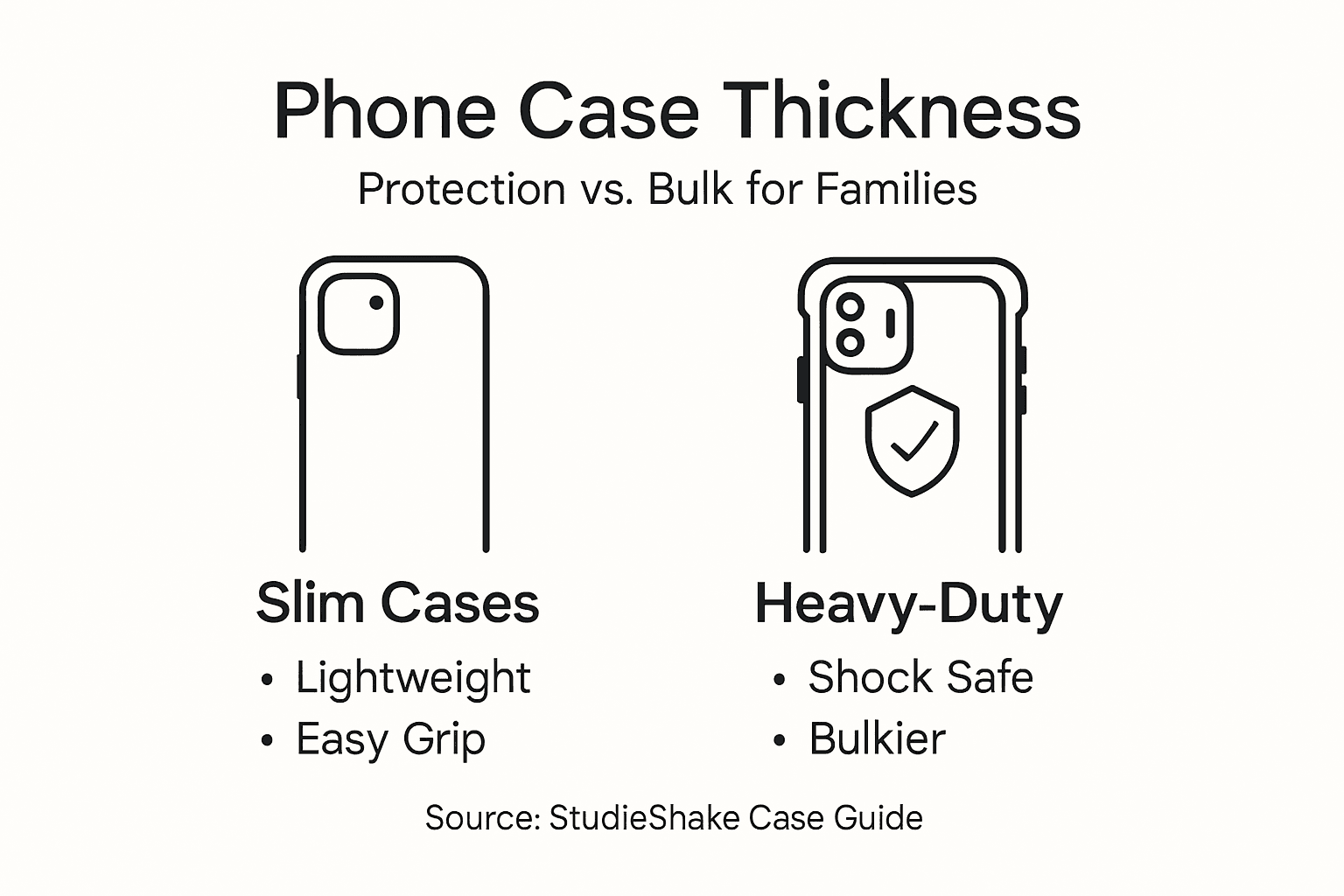
Slim cases prioritise portability and minimalist design, offering lightweight scratch protection with subtle device enhancement. These cases maintain smartphone aesthetics while providing a basic protective layer. Conversely, heavy-duty cases feature multi-layered constructions with robust shock-absorption capabilities, designed for high-impact environments and active family lifestyles.
Key differentiating factors between slim and heavy-duty cases include:
- Impact resistance levels
- Overall device profile
- Material complexity
- Weight distribution
- Compatibility with accessories
- Visual aesthetics
The optimal choice depends on individual family requirements. Active families with young children might prioritise maximum protection, while professionals may prefer sleek, understated designs that project a polished image. Technological advances are increasingly bridging this gap, creating cases that offer comprehensive protection without excessive bulk.
For quick reference, here is how slim and heavy-duty cases differ for UK families:
| Feature | Slim Case | Heavy-Duty Case |
|---|---|---|
| Device Profile | Thin, minimal bulk | Bulky, reinforced edges |
| Shock Absorption | Basic drop defence | High-impact, layered |
| Weight | Lightweight | Noticeably heavier |
| Common Use | Office, daily city | Outdoor, active children |
| Accessory Fit | Highly compatible | Sometimes restricted |
Pro tip: Consider your typical daily environment and device handling patterns when selecting between slim and heavy-duty case options.
Protect Your Family’s Devices with the Perfect Case Thickness
Choosing the right phone case thickness is a challenge that many UK families face when trying to protect their smartphones from daily bumps, drops, and spills. The article highlights the dilemma between durability and bulkiness, showing how the right case can balance excellent impact absorption with comfortable handling and pocket compatibility. At StudioShake, we understand these concerns and offer a wide range of phone cases designed to suit every family lifestyle — from slim, sleek options to rugged, heavy-duty protection.
Explore our specially curated collections like the iPhone – StudioShake lineup and the customer-favourite Our Bestsellers – StudioShake for tested protection backed by quality and style.
Don’t compromise on your device’s safety or your family’s convenience. Visit StudioShake now to discover cases that perfectly blend protection, practicality, and style. Find the best fit for your family’s needs and safeguard your smartphones today.
Frequently Asked Questions
How does phone case thickness impact device protection?
Thicker phone cases generally provide better impact absorption by distributing forces more effectively across multiple reinforced layers. However, excessive thickness can affect ergonomics and pocket compatibility.
What are the benefits of using a slim phone case instead of a heavy-duty case?
Slim cases prioritise portability, offering lightweight scratch protection while maintaining the phone’s aesthetics. Heavy-duty cases, on the other hand, provide robust multi-layered protection for high-impact environments but are bulkier and heavier.
Are there specific materials that enhance the protection offered by phone cases?
Yes, advanced materials like silicone, TPU, and polycarbonate are commonly used in cases to balance durability, weight, and shock absorption, enhancing overall protection without unnecessary bulk.
How do I choose the right phone case thickness for my family’s needs?
Consider your family’s lifestyle and device handling patterns; active families may opt for thicker cases for maximum protection, while professionals might prefer sleeker, thinner designs that maintain a polished appearance.
Recommended
- Phone Case Sizes – Ensuring the Perfect Fit for Every Family – StudioShake
- 7 Smart Tips for Choosing Phone Cases for Families in the UK – StudioShake
- Why UK-Made Cases Matter for Family Devices – StudioShake
- Impact Resistance in Phone Cases – Why It Matters for Families – StudioShake
- Complete Guide to Why Choose Lightweight Footwear – YDA UK